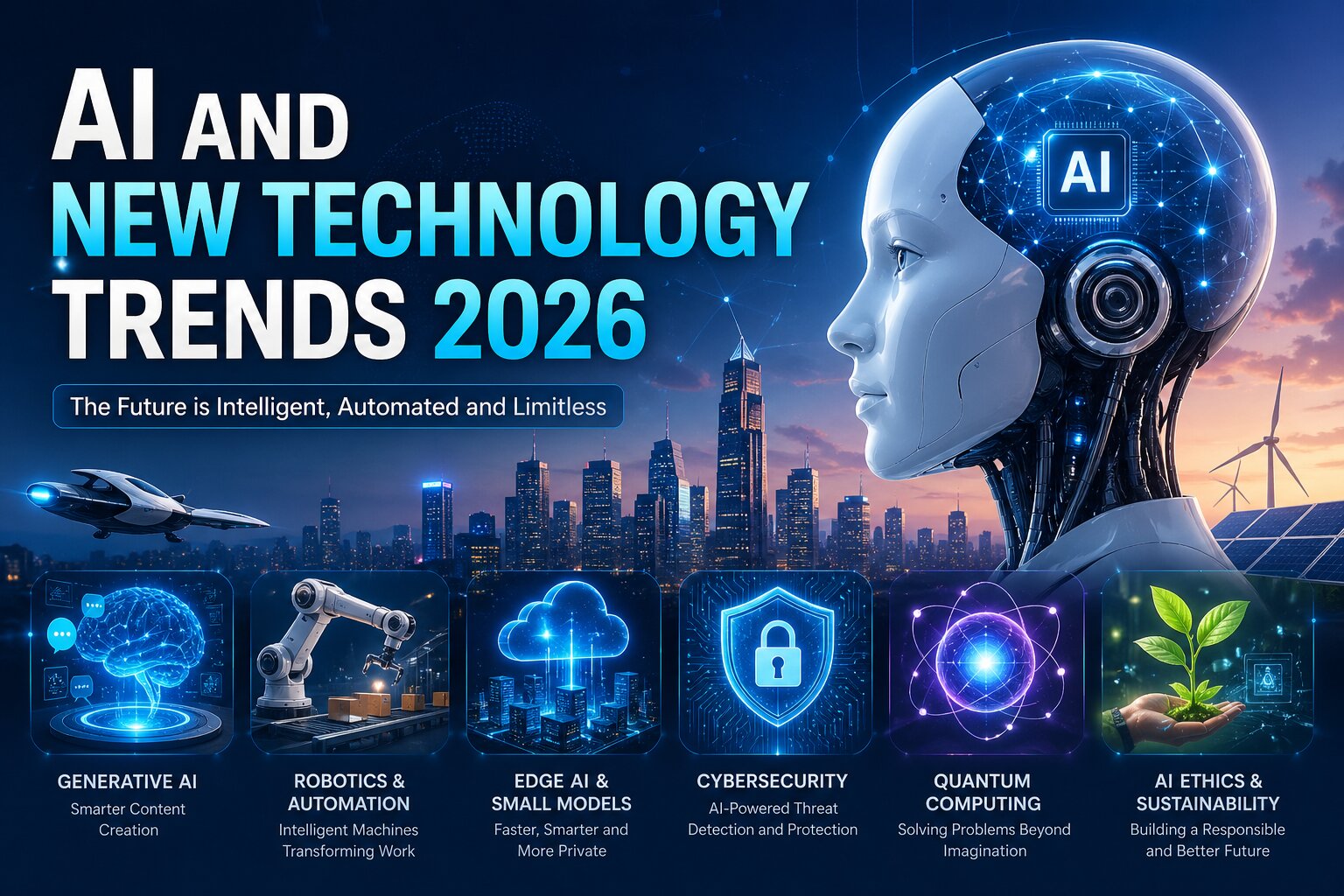
AI and New Technology Trends 2026
Technology is evolving faster than ever, and AI and New Technology Trends 2026 are shaping the future of business, education, healthcare, finance, and daily life. Artificial Intelligence is no longer just a concept for big tech companies—it has become part of everyday tools, smartphones, customer service, online shopping, and even government systems. In 2026, AI is moving from simple automation to intelligent decision-making, while new technologies like robotics, quantum computing, cybersecurity, and smart devices are transforming industries worldwide.
Experts highlight that AI-native development platforms, multiagent systems, physical AI, digital provenance, and confidential computing are among the top strategic technology trends of 2026. Gartner notes that AI is no longer optional for organizations and is now essential for building resilient and intelligent systems. Deloitte also emphasizes that businesses are shifting from asking “What can AI do?” to “How can AI create measurable business impact?” This article explores the most important AI and New Technology Trends 2026 and how they are changing the world.
Rise of Generative AI in 2026
Here’s what you need to know:
Generative AI remains one of the biggest parts of AI and New Technology Trends 2026. Tools that create text, images, videos, music, and code are becoming smarter and more accurate. Businesses are using generative AI for content creation, customer support, product design, and software development. Students use AI tools for research assistance, while freelancers use them for faster project delivery.
In 2026, generative AI is becoming multimodal, meaning it can understand and create content using text, voice, images, and video together. This makes communication with machines more natural and efficient. AI is also becoming embedded inside apps instead of being used as a separate tool, making the experience smoother for users. Reddit discussions and industry reports also point to hyper-personalization and AI coding assistants as major developments this year.
AI Writing and Content Creation
AI writing assistants are now helping journalists, bloggers, and businesses create SEO-friendly content quickly. News websites, eCommerce stores, and digital marketers rely on AI for product descriptions, blog posts, and social media captions. However, human editing remains important to ensure originality, trust, and emotional connection.
AI Video and Design Tools
Video generation tools are growing rapidly in 2026. Users can create professional videos using only prompts, making content creation faster for YouTubers, advertisers, and educators. Graphic design tools powered by AI also allow beginners to create logos, banners, and social media posts without advanced design skills.
Agentic AI and Autonomous Systems
One of the strongest AI and New Technology Trends 2026 is Agentic AI. This refers to AI systems that can perform tasks independently with less human supervision. Instead of only answering questions, these systems can plan actions, analyze data, and complete workflows automatically.
TechTarget identifies Agentic AI as one of the top AI trends for 2026 because it supports automation, reasoning, and adaptation at scale. Businesses are using AI agents for customer service, appointment scheduling, data analysis, and sales management.
AI as a Digital Employee
Companies now describe AI as a “digital employee” because it can manage repetitive tasks like email replies, ticket handling, lead qualification, and workflow automation. This reduces costs and improves productivity while allowing human workers to focus on strategy and creativity.
Multiagent Systems
Gartner also lists Multiagent Systems among the top technology trends of 2026. These are groups of AI agents working together to complete complex tasks. For example, one AI may collect customer data, another may analyze it, and a third may generate reports automatically.
Physical AI and Robotics
Physical AI is another major part of AI and New Technology Trends 2026. This trend combines artificial intelligence with robotics to create machines that can interact with the physical world. These robots are being used in factories, hospitals, warehouses, agriculture, and even homes.
Deloitte highlights the convergence of AI and robotics as a key 2026 trend, showing how autonomous systems are moving from niche industries into mainstream business operations. Robotics powered by AI can improve speed, reduce errors, and operate in dangerous environments where human safety is a concern.
Smart Manufacturing
Factories are using AI robots for packaging, assembly, and quality control. These robots can learn from mistakes and improve performance over time, making manufacturing faster and more reliable.
Healthcare Robotics
Hospitals use robotic assistants for surgery support, patient monitoring, and medicine delivery. AI improves diagnosis speed and helps doctors make better decisions using medical data and predictive analysis.
Small Language Models and Edge AI
While large AI models remain powerful, 2026 is also seeing growth in Small Language Models (SLMs). These are lighter and faster models that can run directly on smartphones, laptops, and smart devices without requiring massive cloud servers.
This trend improves privacy, speed, and affordability. Users can access AI offline and reduce dependence on internet-based systems. Many experts see this as one of the most practical AI and New Technology Trends 2026, especially for startups and businesses looking for cost-effective solutions.
Privacy-Focused AI
Because SLMs work locally, sensitive personal data does not always need to be sent to external servers. This improves user trust and supports stronger data protection standards.
AI in Smartphones
Smartphones in 2026 are becoming more intelligent with on-device AI for voice recognition, translation, camera improvements, and personalized recommendations without relying heavily on cloud services.
Cybersecurity and AI Security Platforms
As AI grows, cybersecurity becomes even more important. Hackers also use AI, making digital threats smarter and faster. Because of this, AI-powered defense systems are becoming a top priority in AI and New Technology Trends 2026.
Gartner includes AI Security Platforms and Preemptive Cybersecurity among its top strategic technology trends. These systems detect threats early, monitor suspicious activity, and respond faster than traditional security tools.
Zero-Trust Security
Businesses are adopting zero-trust security models where every user and device must be verified continuously. AI helps manage this process efficiently and reduces the risk of unauthorized access.
Digital Provenance
Digital provenance helps verify whether content is original or manipulated. This is especially important in 2026 because of deepfakes and misinformation created by AI tools. Verified content builds trust in journalism, business communication, and public information.
Quantum Computing and Future Innovation
Quantum computing is moving from research labs into selective enterprise use, making it one of the most exciting AI and New Technology Trends 2026. It can solve highly complex problems much faster than traditional computers in areas like finance, logistics, and scientific research.
Although still expensive and limited, early adoption is helping industries prepare for the future. Quantum systems may transform drug discovery, fraud detection, and supply chain optimization over the next few years.
Business Impact of Quantum Computing
Companies in banking and healthcare are already exploring quantum computing for simulations and predictive models. Early adopters may gain strong competitive advantages.
AI + Quantum Combination
The future may involve combining AI with quantum computing for even faster decision-making and problem-solving. This could unlock breakthroughs that are impossible with current systems.
AI Ethics, Regulation, and Responsible Innovation
As AI becomes more powerful, governments and institutions are increasing regulation. Ethical AI is now a major topic within AI and New Technology Trends 2026 because privacy, bias, misinformation, and job displacement are serious concerns.
Reports show stronger focus on governance, data protection, and institutional integrity. Even global institutions are working to define ethical standards for AI use and truth verification. Responsible AI ensures that technology supports society rather than creating harm.
AI and Employment
Many companies are using AI to improve efficiency, but this also raises concerns about job losses. Recent reports show large tech firms adjusting workforces while increasing AI investment, creating debate about the future of employment. Workers must focus on learning digital skills, creativity, and problem-solving to stay competitive.
Need for Human Oversight
AI should support human decisions, not replace human responsibility. Ethical oversight, transparency, and accountability are necessary to build trust in AI systems.
Conclusion
The future of technology is being shaped by AI and New Technology Trends 2026, and the world is entering a new era of intelligent systems. From generative AI and autonomous agents to robotics, cybersecurity, and quantum computing, innovation is changing how people work, learn, and live. Businesses are no longer experimenting with AI—they are building their future around it.
Success in 2026 depends on understanding these changes and adapting quickly. Whether you are a student, freelancer, entrepreneur, or business owner, learning how to work with AI is becoming more important than ever. AI is not replacing human potential—it is expanding it. The real opportunity lies in using technology wisely, ethically, and strategically for long-term growth.