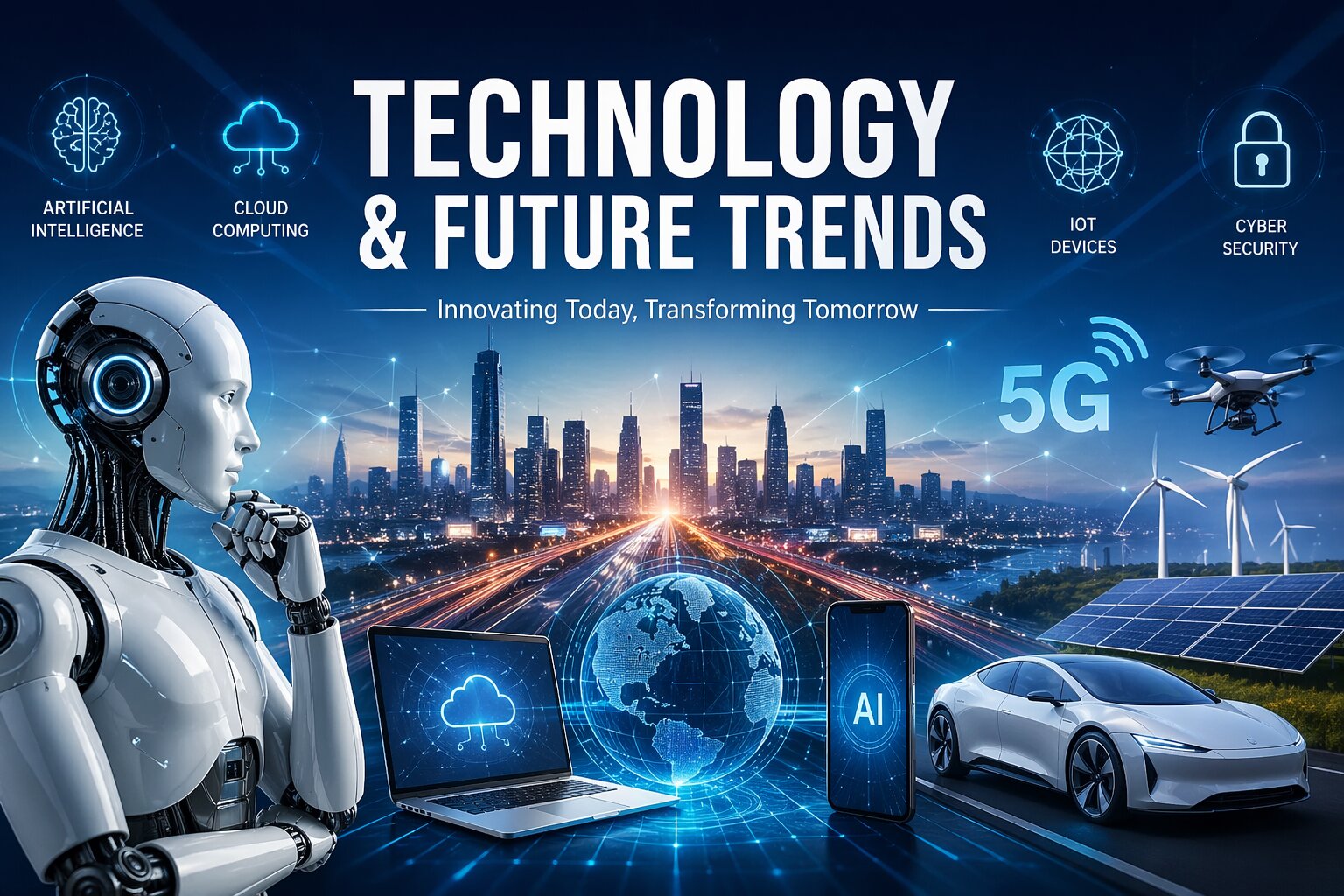
Technology & Future Trends: Shaping the World of Tomorrow
Technology & Future Trends are rapidly transforming the way we live, work, and interact with the world. From artificial intelligence to quantum computing, the pace of innovation has accelerated dramatically over the past decade. As we move deeper into the digital age, businesses, governments, and individuals are all adapting to a future driven by smart systems, automation, and data intelligence. Understanding Technology & Future Trends is no longer optional—it is essential for staying relevant in a competitive global environment. These trends influence everything from healthcare and education to transportation and communication, creating both opportunities and challenges that must be navigated carefully.
The future of technology is not just about faster devices or smarter apps; it is about redefining human experiences and solving complex global problems. Emerging technologies are reshaping industries by improving efficiency, reducing costs, and enabling innovation at unprecedented levels. As we explore the major Technology & Future Trends, it becomes clear that the next decade will be defined by connectivity, intelligence, and sustainability.
Artificial Intelligence and Machine Learning
Here’s what you need to know:
The Rise of Intelligent Systems
Artificial Intelligence (AI) and Machine Learning (ML) are at the core of modern Technology & Future Trends. These technologies enable machines to learn from data, make decisions, and improve over time without human intervention. AI is already being used in various industries, including healthcare, finance, retail, and transportation. From virtual assistants to predictive analytics, AI is enhancing productivity and transforming how businesses operate.
Machine learning algorithms analyze massive datasets to identify patterns and generate insights that were previously impossible to obtain. This capability allows companies to personalize customer experiences, optimize operations, and make data-driven decisions. As AI continues to evolve, it is expected to become more autonomous, ethical, and integrated into everyday life.
Impact on Jobs and Society
While AI offers numerous benefits, it also raises concerns about job displacement and ethical considerations. Automation is replacing repetitive tasks, which may lead to changes in the workforce. However, it also creates new opportunities in fields such as data science, AI development, and cybersecurity. The key to adapting to these Technology & Future Trends is reskilling and embracing lifelong learning.
The Expansion of the Internet of Things (IoT)
Connecting the World
The Internet of Things (IoT) is another major component of Technology & Future Trends. IoT refers to the network of interconnected devices that communicate and share data with each other. These devices include smart home appliances, wearable gadgets, industrial sensors, and connected vehicles. The growth of IoT is making our environments smarter and more efficient.
Smart homes, for example, allow users to control lighting, temperature, and security systems remotely. In industries, IoT devices monitor equipment performance and predict maintenance needs, reducing downtime and costs. This interconnected ecosystem is transforming how we interact with technology in our daily lives.
Data and Security Challenges
As IoT devices generate vast amounts of data, managing and securing this information becomes critical. Cybersecurity is a major concern in the era of Technology & Future Trends, as connected devices can be vulnerable to attacks. Organizations must invest in robust security measures to protect sensitive data and ensure the reliability of IoT systems.
5G Technology and Connectivity Revolution
Faster and More Reliable Networks
The rollout of 5G technology is a significant milestone in Technology & Future Trends. With faster speeds, lower latency, and higher capacity, 5G enables seamless connectivity and supports advanced applications such as autonomous vehicles, remote surgery, and smart cities. This next-generation network is expected to revolutionize communication and enhance user experiences.
5G technology also supports the growth of IoT by providing the infrastructure needed for billions of connected devices. It enables real-time data transmission, which is crucial for applications that require instant responses. As 5G becomes more widespread, it will unlock new possibilities for innovation and development.
Blockchain and Decentralization
Beyond Cryptocurrency
Blockchain technology is often associated with cryptocurrencies, but its potential extends far beyond digital currencies. As part of Technology & Future Trends, blockchain offers a secure and transparent way to record transactions and manage data. It is being used in supply chain management, healthcare, finance, and voting systems.
Blockchain eliminates the need for intermediaries, reducing costs and increasing efficiency. Its decentralized nature ensures that data is tamper-proof and trustworthy. This makes it an ideal solution for industries that require high levels of security and transparency.
Quantum Computing: The Next Frontier
Revolutionizing Computing Power
Quantum computing represents one of the most exciting Technology & Future Trends. Unlike traditional computers, which use bits, quantum computers use quantum bits (qubits) that can exist in multiple states simultaneously. This allows them to perform complex calculations at incredible speeds.
Quantum computing has the potential to revolutionize fields such as cryptography, drug discovery, and climate modeling. Although still in its early stages, this technology is expected to solve problems that are currently beyond the capabilities of classical computers.
Sustainable Technology and Green Innovation
Technology for a Better Planet
Sustainability is becoming a key focus in Technology & Future Trends. As environmental concerns grow, there is an increasing demand for technologies that reduce carbon emissions and promote eco-friendly practices. Renewable energy, electric vehicles, and smart grids are examples of innovations that support sustainability.
Companies are also adopting green technologies to minimize their environmental impact. From energy-efficient data centers to sustainable manufacturing processes, technology is playing a crucial role in addressing climate change and preserving natural resources.
The Future of Work and Remote Collaboration
Digital Transformation of Workplaces
The future of work is being reshaped by Technology & Future Trends. Remote work, digital collaboration tools, and virtual offices have become more common, especially after global events that accelerated digital adoption. Technologies such as cloud computing and video conferencing enable employees to work from anywhere in the world.
This shift has increased flexibility and productivity while reducing the need for physical office spaces. However, it also requires organizations to rethink their management strategies and invest in digital infrastructure.
Augmented Reality (AR) and Virtual Reality (VR)
Immersive Experiences
AR and VR are transforming how we experience digital content. These technologies are part of the broader Technology & Future Trends that focus on immersive experiences. AR overlays digital information onto the real world, while VR creates fully virtual environments.
These technologies are being used in gaming, education, healthcare, and training. For example, medical students can practice surgeries in a virtual environment, and businesses can use VR for employee training. As AR and VR continue to advance, they will become more accessible and widely adopted.
Cybersecurity in the Digital Age
Protecting Digital Assets
As technology evolves, so do cyber threats. Cybersecurity is a critical aspect of Technology & Future Trends, as businesses and individuals rely more on digital systems. Protecting data, networks, and systems from cyberattacks is essential for maintaining trust and security.
Organizations must implement advanced security measures, such as encryption, multi-factor authentication, and threat detection systems. Additionally, raising awareness about cybersecurity best practices is crucial for preventing attacks and safeguarding sensitive information.
Conclusion: Embracing the Future of Technology
Technology & Future Trends are shaping a world that is more connected, intelligent, and innovative than ever before. From AI and IoT to blockchain and quantum computing, these advancements are transforming industries and redefining possibilities. While challenges such as cybersecurity and job displacement must be addressed, the benefits of technological progress far outweigh the risks.
To succeed in this rapidly evolving landscape, individuals and organizations must stay informed, adapt to change, and embrace innovation. The future belongs to those who are willing to learn, experiment, and leverage technology to create meaningful impact. As we continue to explore Technology & Future Trends, one thing is certain—the journey of innovation has only just begun.