How to Transition Between Paragraphs in a University Essay
Writing a strong academic essay is not only about having good ideas and solid research; it is also about how smoothly those ideas connect together. One of the most important but often overlooked academic skills is how to transition between paragraphs in a university essay. Good transitions help your essay flow logically, making it easier for the reader to follow your argument from one point to the next. Without effective transitions, even excellent ideas can feel disconnected, confusing, or repetitive. In university-level writing, lecturers are not just looking at what you say, but also how clearly and coherently you say it. This is why mastering paragraph transitions is essential for achieving higher grades and producing professional academic work.
Understanding the Purpose of Transitions in Academic Writing
Here’s what you need to know:
To fully understand how to transition between paragraphs in a university essay, it is important to first understand why transitions matter. Transitions act like bridges between ideas, guiding the reader from one paragraph to another without losing the logical flow of the argument. In academic writing, each paragraph should focus on a single main idea, but those ideas must still connect to the overall thesis. Without transitions, your essay becomes a list of separate points rather than a structured argument.
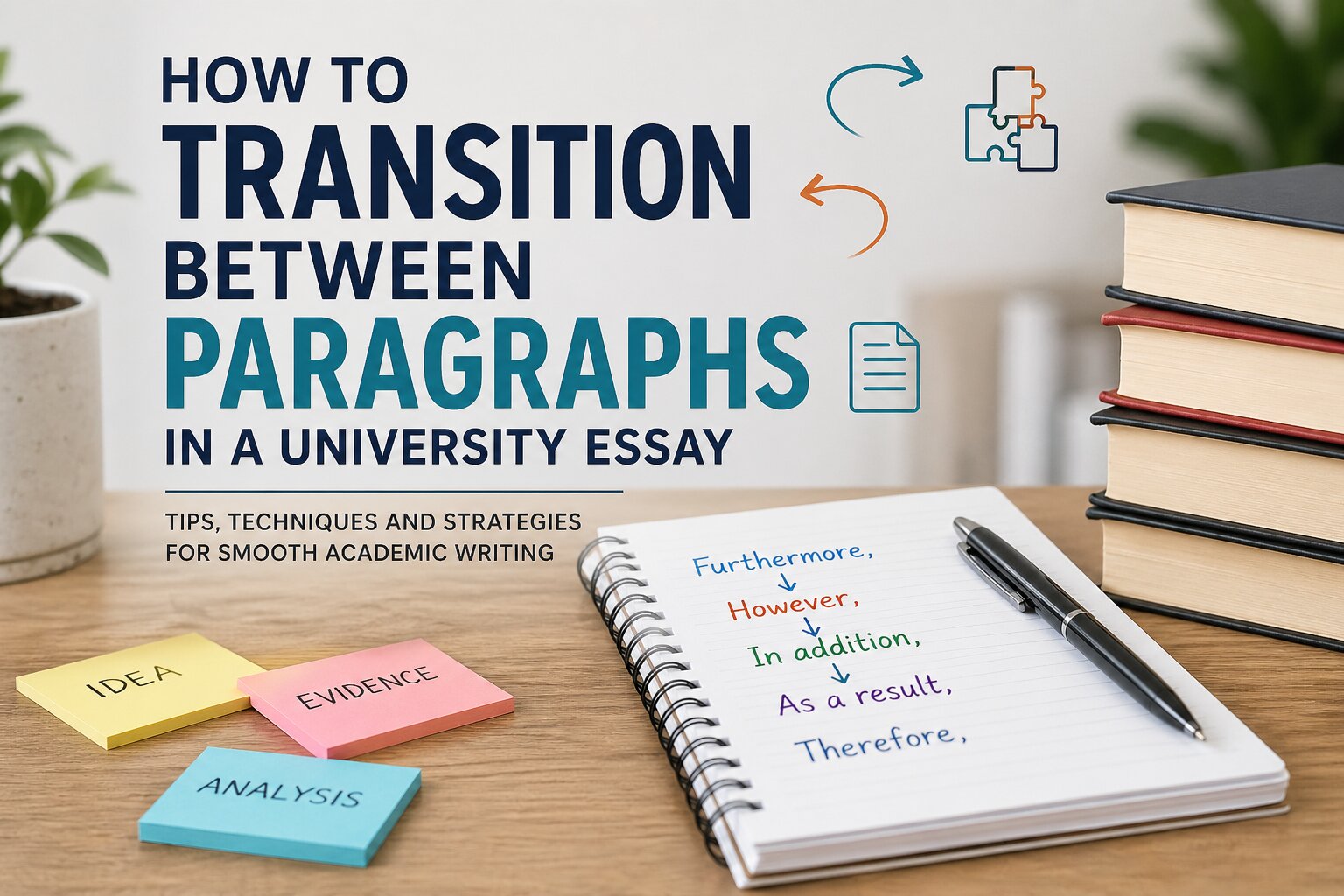
A well-written transition does more than simply connect sentences—it shows the relationship between ideas. For example, it can indicate contrast (“however,” “on the other hand”), addition (“furthermore,” “in addition”), cause and effect (“therefore,” “as a result”), or sequence (“firstly,” “subsequently”). When you learn how to transition between paragraphs in a university essay, you are essentially learning how to guide your reader through your thinking process in a clear and persuasive way.
Another important function of transitions is maintaining coherence. Coherence means that all parts of your essay feel connected and logically organized. Even if your ideas are strong, poor transitions can make your essay feel fragmented. This is especially important in long academic essays, where multiple arguments and pieces of evidence must work together. Transitions ensure that each paragraph builds on the previous one, strengthening your overall argument instead of weakening it.
Techniques for Smooth Paragraph Transitions in University Essays
When learning how to transition between paragraphs in a university essay, it is useful to focus on practical techniques that improve writing flow. One of the most effective methods is the use of transitional words and phrases. Words like “however,” “moreover,” “in contrast,” and “for example” help signal the relationship between ideas. However, relying only on these words is not enough; strong academic transitions also require sentence-level and idea-level connections.
A more advanced technique is to use the final sentence of a paragraph to lead into the next idea. This is often called a “linking sentence.” Instead of ending a paragraph abruptly, you can briefly hint at what comes next. For example, if one paragraph discusses economic causes of climate change, the final sentence might introduce social consequences, setting up the next paragraph naturally. This approach is central to mastering how to transition between paragraphs in a university essay, because it ensures continuity rather than sudden topic shifts.
Another effective method is to repeat or rephrase key terms from the previous paragraph. This technique creates thematic continuity. For instance, if your paragraph discusses “student motivation,” the next paragraph might begin by expanding on “this motivation” or “such motivational factors.” This subtle repetition helps the reader see that the ideas are connected, not separate.
You can also use comparative structures when transitioning between contrasting ideas. Phrases such as “while the previous section focused on X, this section examines Y” are extremely useful in analytical essays. They clearly show the shift in argument while maintaining coherence. By combining these techniques, students can significantly improve their understanding of how to transition between paragraphs in a university essay and produce more professional, readable work.
Common Mistakes Students Make in Paragraph Transitions
Even when students understand the theory of how to transition between paragraphs in a university essay, they often make practical mistakes that weaken their writing. One of the most common errors is using transitions mechanically or excessively. Overusing words like “however,” “therefore,” or “in addition” can make writing sound repetitive and artificial. Transitions should support meaning, not replace it.
Another frequent mistake is introducing completely unrelated ideas without preparation. When a new paragraph starts too abruptly, the reader is forced to adjust suddenly, which disrupts the flow of the essay. This usually happens when students focus too much on individual paragraphs instead of the overall structure. Effective transitions require planning at the essay level, not just the paragraph level.
Students also often forget to connect back to the thesis statement when transitioning between paragraphs. Each paragraph should contribute to the central argument, and transitions should reinforce that connection. Without this, the essay may feel like a collection of notes rather than a unified academic argument. Understanding how to transition between paragraphs in a university essay involves always keeping the main argument in mind and ensuring that each paragraph leads logically to the next.
Another issue is redundancy, where students repeat the same idea in different words without adding new insight. While repetition can be useful for continuity, excessive repetition weakens clarity and reduces the academic quality of writing. Strong transitions should clarify relationships between ideas, not simply restate them.
Strategies to Improve Your Transition Skills in Essays
Improving your ability to handle how to transition between paragraphs in a university essay requires practice, awareness, and revision. One effective strategy is to outline your essay before writing. A clear outline helps you see how each paragraph connects to the next, making it easier to plan transitions in advance. When you understand the logical structure of your argument, writing smooth transitions becomes much easier.
Another useful strategy is to read academic essays written by experts. Pay attention to how professional writers move from one idea to another. You will notice that transitions are often subtle and integrated into sentences rather than forced or obvious. This kind of exposure helps you develop a natural sense of flow in your own writing.
Peer review is also a powerful tool. Asking someone else to read your essay can help you identify where transitions are unclear or missing. Sometimes, what seems logical to the writer may not be clear to the reader. Feedback helps you refine your understanding of how to transition between paragraphs in a university essay from the reader’s perspective.
Additionally, revising your essay specifically for transitions is crucial. During editing, check each paragraph and ask yourself: Does this connect clearly to the previous one? Does it lead naturally to the next idea? Are the relationships between ideas explicit? This focused revision process significantly improves essay quality and ensures smoother flow throughout your work.
Mastering Paragraph Transitions for Academic Success
Ultimately, mastering how to transition between paragraphs in a university essay is about developing clarity of thought and structure. Good transitions reflect good thinking. When your ideas are logically connected in your mind, it becomes easier to express them in writing. Academic success is not just about strong arguments but also about presenting those arguments in a coherent and persuasive way.
Transitions help transform a simple essay into a well-structured academic discussion. They allow your reader to follow your reasoning step by step, which is essential in university-level writing. Whether you are writing an argumentative essay, a research paper, or a literature review, strong transitions improve readability and strengthen your academic voice.
In conclusion, learning how to transition between paragraphs in a university essay is a skill that requires attention to structure, language, and logical flow. By using linking sentences, transitional phrases, and careful planning, students can significantly improve the quality of their essays. Avoiding common mistakes and practicing revision strategies further enhances writing performance. With consistent practice, transitions become a natural part of your academic writing style, helping you produce clearer, more persuasive, and higher-quality university essays.