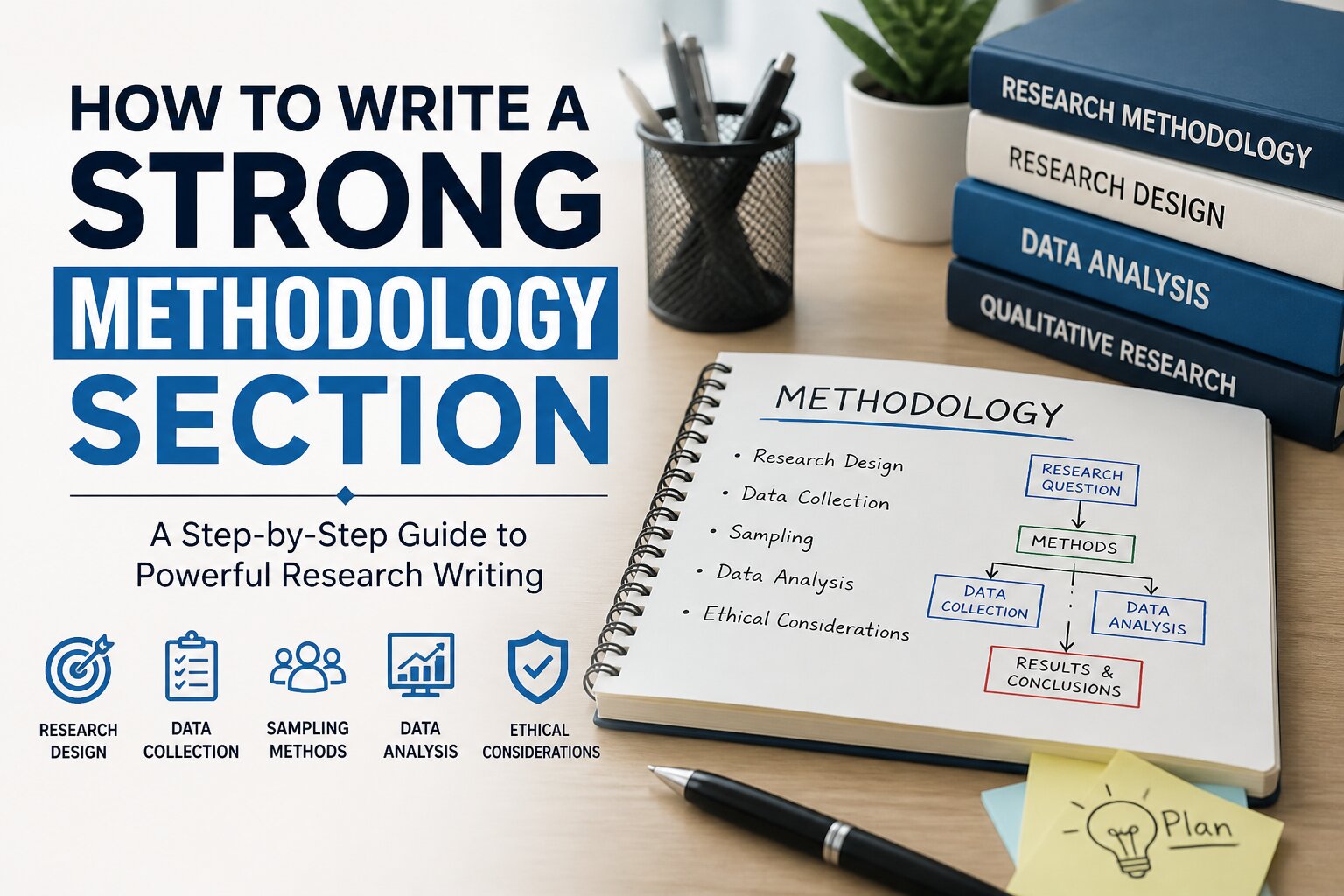
How to Write a Strong Methodology Section.
Writing a strong methodology section is one of the most critical parts of any academic research paper, dissertation, or thesis. It provides the foundation for your study by explaining how your research was conducted, what methods were used, and why those methods were appropriate for your objectives. A well-crafted methodology section not only enhances the credibility of your research but also allows other researchers to replicate your study. Understanding how to write a strong methodology section requires clarity, structure, and a logical explanation of your research design, data collection, and analysis techniques. This guide will walk you through every essential component needed to create a powerful and effective methodology section that meets academic standards.
Understanding the Purpose of a Methodology Section
Here’s what you need to know:
What is a Methodology Section?
The methodology section explains the process you followed to conduct your research. It outlines your research approach, tools, and techniques in a clear and systematic way. When learning how to write a strong methodology section, it is important to remember that this section should justify your choices and demonstrate that your research is reliable and valid.
Why is it Important?
A strong methodology section builds trust with your readers. It shows that your research is not based on assumptions but on structured and tested methods. It also allows others to evaluate the accuracy of your findings and replicate your study if needed. Without a clear methodology, even the most interesting research topic can lose its credibility.
Key Components of a Strong Methodology Section
Research Design
The research design is the overall strategy you choose to integrate the different components of your study. It answers the question: How will you conduct your research? When explaining how to write a strong methodology section, start by identifying whether your research is qualitative, quantitative, or mixed-methods.
- Qualitative research focuses on understanding concepts, experiences, or opinions.
- Quantitative research involves numerical data and statistical analysis.
- Mixed-methods research combines both approaches.
Clearly explain why you selected your specific design and how it aligns with your research objectives.
Research Approach
Your research approach can be inductive or deductive:
- Inductive approach: Builds theories based on observations.
- Deductive approach: Tests existing theories through data.
Choosing the right approach is essential when learning how to write a strong methodology section, as it shapes the entire structure of your research.
Data Collection Methods
Primary Data Collection
Primary data is collected directly from original sources. Common methods include:
- Surveys and questionnaires
- Interviews
- Observations
When describing your primary data collection, include details such as sample size, sampling techniques, and data collection procedures. This level of detail is crucial in mastering how to write a strong methodology section.
Secondary Data Collection
Secondary data involves using existing information such as books, journals, and online databases. If you use secondary data, explain:
- Sources of data
- Criteria for selection
- Relevance to your research
Providing transparency in your data sources strengthens your methodology.
Sampling Techniques
Types of Sampling
Sampling is the process of selecting a subset of individuals from a population. There are two main types:
- Probability sampling (random selection)
- Non-probability sampling (non-random selection)
Explain which sampling method you used and why it is suitable for your research. A clear explanation of sampling is essential when understanding how to write a strong methodology section.
Sample Size Justification
You should also justify your sample size. Explain why the number of participants or data points is sufficient to support your findings. This adds credibility to your research.
Data Analysis Techniques
Qualitative Data Analysis
If your research is qualitative, you may use methods such as:
- Thematic analysis
- Content analysis
- Narrative analysis
Describe how you identified patterns and interpreted the data.
Quantitative Data Analysis
For quantitative research, include:
- Statistical tests used
- Software tools (e.g., SPSS, Excel)
- Data presentation methods
Explaining your analysis process clearly is a key step in learning how to write a strong methodology section.
Ethical Considerations
Ethics play a vital role in research. You must ensure that your study follows ethical guidelines, such as:
- Obtaining informed consent
- Ensuring participant confidentiality
- Avoiding data manipulation
Including ethical considerations shows that your research is responsible and trustworthy. This is an essential part of how to write a strong methodology section.
Limitations of the Methodology
No research is perfect, and acknowledging limitations is important. Some common limitations include:
- Small sample size
- Limited access to data
- Time constraints
Discussing limitations does not weaken your research; instead, it demonstrates honesty and critical thinking. This is another important aspect of how to write a strong methodology section.
Tips for Writing a Strong Methodology Section
Be Clear and Concise
Avoid unnecessary jargon and keep your explanations simple and direct. Clarity is essential when explaining how to write a strong methodology section.
Use Past Tense
Since the methodology describes what you have already done, it should be written in the past tense.
Be Detailed but Relevant
Provide enough detail for replication, but avoid including irrelevant information.
Justify Your Choices
Always explain why you selected a particular method. Justification is key to mastering how to write a strong methodology section.
Common Mistakes to Avoid
- Lack of detail: Not explaining methods clearly
- Overcomplication: Using complex language unnecessarily
- Missing justification: Not explaining why methods were chosen
- Ignoring limitations: Failing to acknowledge weaknesses
Avoiding these mistakes will significantly improve your methodology section.
Conclusion
Learning how to write a strong methodology section is essential for producing high-quality academic research. This section acts as the backbone of your study, providing a clear roadmap of how your research was conducted. By carefully explaining your research design, data collection methods, sampling techniques, and analysis procedures, you can create a methodology that is both credible and effective. Remember to maintain clarity, justify your choices, and follow ethical guidelines. A strong methodology section not only strengthens your research but also enhances its overall impact and reliability.
Final Thoughts
Mastering how to write a strong methodology section takes practice, attention to detail, and a clear understanding of research principles. Whether you are writing a dissertation, thesis, or research paper, investing time in crafting a solid methodology will greatly improve the quality of your work. By following the guidelines outlined in this article, you can confidently create a methodology section that meets academic standards and supports your research objectives.