
Introduction
Here’s what you need to know:
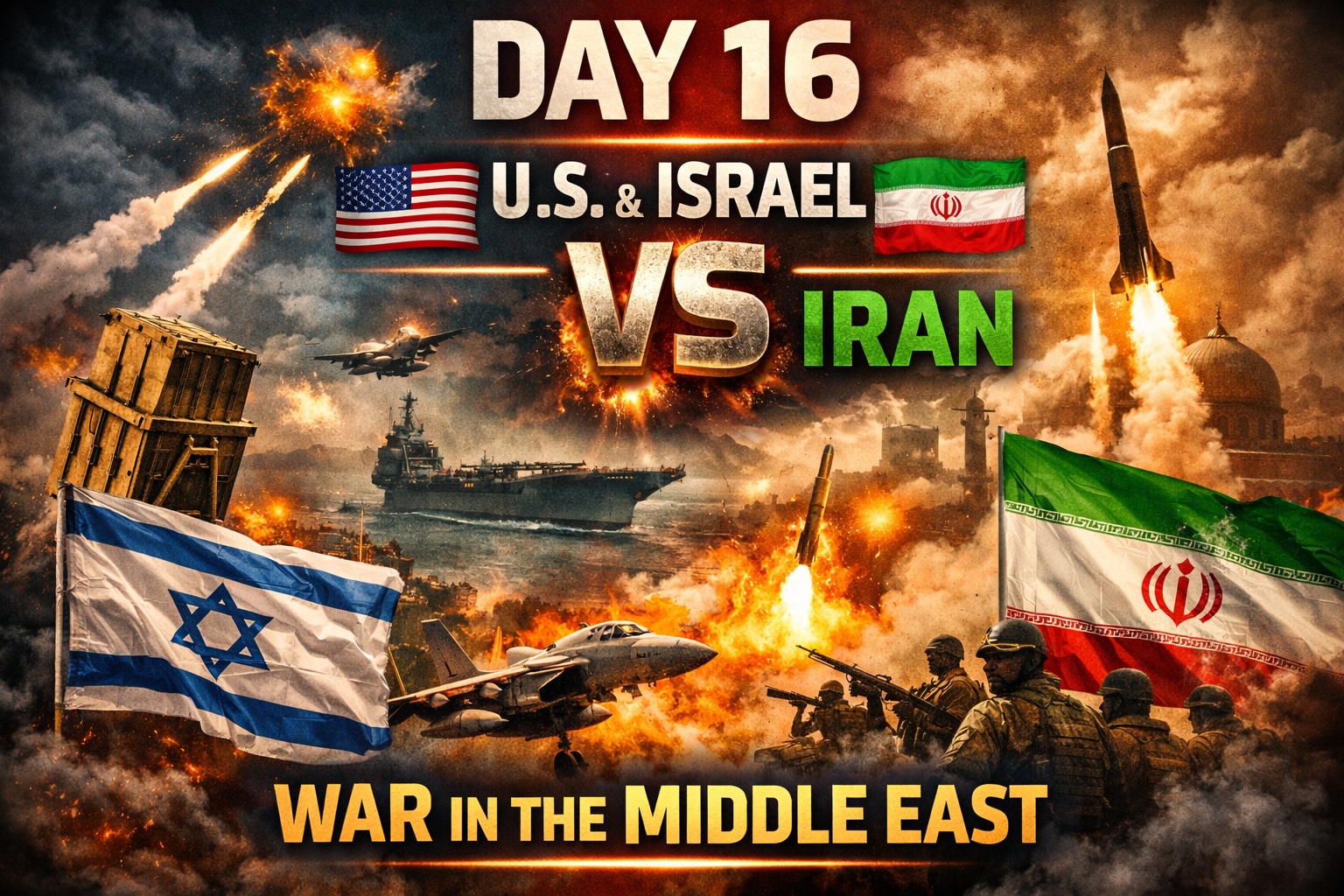
Sixteen days after the outbreak of war between Israel, the United States and Iran, the Middle East remains on edge as airstrikes, missile attacks and diplomatic manoeuvres continue across the region. What began as a coordinated military operation targeting Iranian facilities has escalated into one of the most dangerous confrontations in decades.
The conflict has already disrupted global energy markets, forced airspace closures across parts of the Middle East, and raised fears of a wider regional war. European leaders — including those in the United Kingdom — are closely monitoring developments as the humanitarian and geopolitical consequences unfold.
This article outlines what we know on the 16th day of the conflict, answering key questions readers are asking, including: How did the Iran war start in 2026? Why is Israel at war with Iran? Who is stronger, Israel or Iran? and Has Iran and Israel agreed to stop the war?
How Did the Iran War Start in 2026?
The current conflict began on 28 February 2026, when Israel launched a large-scale military campaign against Iranian targets in an operation known as Operation Lion’s Roar. The strikes reportedly involved coordination with the United States and targeted military bases, missile infrastructure and nuclear-related facilities in several Iranian cities.
The attack came after years of rising tensions over:
-
Iran’s nuclear programme
-
Ballistic missile development
-
Iran-backed armed groups across the Middle East
-
Security concerns raised by Israeli leaders
The Israeli government argued that the operation was a pre-emptive strike to neutralise imminent threats. Iran, however, condemned the attacks as an act of aggression and vowed retaliation.
Within hours, Tehran launched ballistic missiles and drones toward Israeli territory and US military installations in the region, escalating the crisis into a full-scale regional confrontation.
Major Developments on Day 16
By the 16th day of the war, several key developments have shaped the battlefield and diplomatic landscape.
Continued Airstrikes Inside Iran
Joint US-Israeli strikes have continued targeting Iranian military facilities. Recent attacks reportedly struck locations near the city of Isfahan, causing casualties and infrastructure damage.
Military analysts say the campaign has focused on:
-
Missile launch sites
-
Revolutionary Guard infrastructure
-
Air defence systems
-
Military command centres
Iranian officials have accused the coalition of striking civilian areas, while Washington and Tel Aviv insist the operations are aimed solely at military targets.
Iranian Retaliation
Iran has responded with waves of missile and drone attacks on Israel and US-linked facilities across the region. Iranian missiles have struck several Israeli locations despite the country’s sophisticated missile defence systems.
In addition, Iranian forces have targeted US military assets and allied countries in the Gulf, including installations in Bahrain.
These retaliatory strikes have heightened fears that the conflict could expand further across the Middle East.
Strategic Strikes on Energy Infrastructure
One of the most significant attacks occurred on 13 March, when US forces carried out a large bombing raid on Kharg Island, a critical Iranian oil export hub. The operation targeted more than 90 military sites on the island.
Although oil infrastructure was reportedly spared, analysts say the strike was designed to pressure Iran by threatening its economic lifeline.
Why Is Israel at War with Iran?
The question “Why is Israel at war with Iran?” reflects a broader geopolitical rivalry that has intensified over the past two decades.
The key drivers of the conflict include:
-
Iran’s nuclear ambitions
Israel has long argued that Tehran is pursuing nuclear weapons capability, which Iran denies. -
Regional proxy conflicts
Iran supports groups such as Hezbollah and other militias that oppose Israel. -
Missile and drone technology
Iranian missile development has raised security concerns in Israel and among Western allies. -
Strategic dominance in the Middle East
Both countries view each other as major regional threats.
These tensions have repeatedly brought the two countries close to direct confrontation, but the 2026 conflict represents the largest direct military clash between them so far.
Who Is Stronger, Israel or Iran?
Another question widely searched online is “Who is stronger, Israel or Iran?”
Military analysts say the answer depends on several factors, including technology, alliances and geography.
Israel’s Advantages
-
Highly advanced air force and missile defence systems
-
Strong intelligence capabilities
-
Military support from the United States
-
Technological superiority
Iran’s Advantages
-
Larger population and manpower
-
Extensive missile arsenal
-
Influence through regional proxy forces
-
Strategic geography controlling key shipping routes
Experts say Israel may hold a technological edge, particularly with US backing, but Iran’s regional networks and missile capabilities mean the conflict could remain prolonged and unpredictable.
Global Impact and Diplomatic Reactions
The war has triggered strong reactions worldwide.
Countries across Europe and Asia have called for restraint. Leaders in France and other European nations have criticised the escalation while urging diplomatic solutions.
Meanwhile, international mediators are attempting to broker dialogue. China has dispatched diplomatic envoys to the region to explore possible ceasefire negotiations.
The conflict has also affected global markets:
-
Shipping insurance costs in the Strait of Hormuz have surged
-
Oil prices have become volatile
-
International airlines have rerouted flights across the Middle East
For the UK and Europe, the biggest concerns include energy security, refugee flows and potential NATO involvement.
Has Iran and Israel Agreed to Stop the War?
As of day 16, no formal ceasefire agreement has been reached.
Diplomatic channels remain open, but both sides continue to exchange strikes. International organisations including the United Nations have urged immediate de-escalation.
Several governments are pushing for:
-
Emergency negotiations
-
Temporary ceasefires for humanitarian aid
-
International mediation
However, analysts warn that both sides appear determined to continue military operations in pursuit of strategic objectives.
What Happens Next?
Experts say the coming days will be critical in determining whether the conflict expands further.
Possible scenarios include:
-
Escalation into a broader regional war
-
Limited ceasefire through international mediation
-
Prolonged air and missile conflict without ground invasion
For now, the situation remains fluid, and the international community is watching closely.
Conclusion
Sixteen days into the war between Israel, the United States and Iran, the conflict has already reshaped the geopolitical landscape of the Middle East. What began as targeted strikes has evolved into a multi-front confrontation involving missile attacks, strategic air raids and intense diplomatic activity.
While global powers continue pushing for negotiations, the absence of a ceasefire suggests the conflict may continue in the near term. For policymakers in the UK and beyond, the stakes are high — affecting global energy markets, regional stability and international security.
As the situation develops, further updates will be crucial in understanding whether diplomacy can halt the escalation or if the crisis will deepen into a wider regional war.