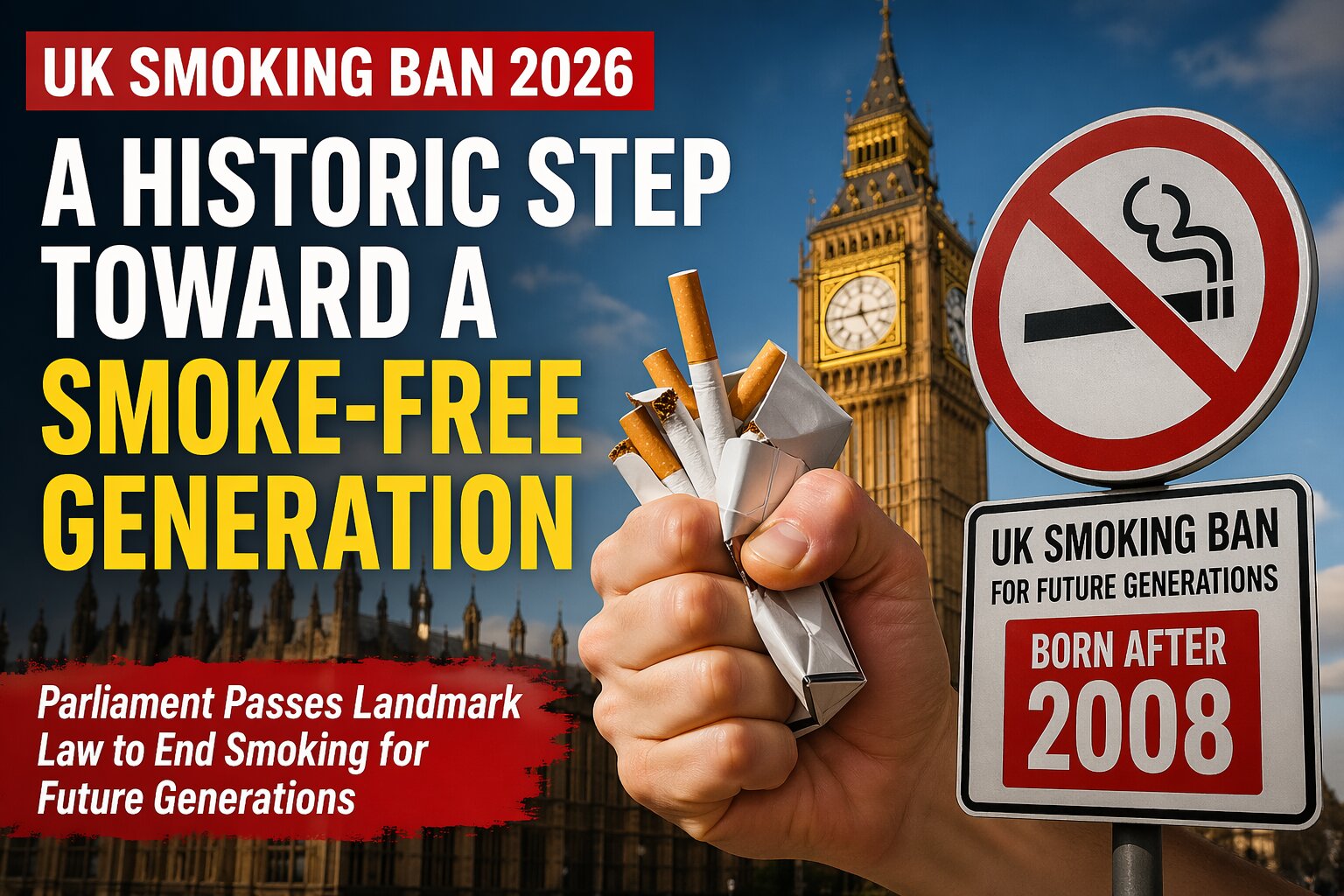
UK Smoking Ban 2026: Britain Moves Toward a Smoke
The UK smoking ban 2026 has become one of the most talked-about public health developments in recent years. The government’s plan to create a “smoke-free generation” is being described as a historic step that could permanently change the future of tobacco use across the country. Under this new legislation, children born on or after January 1, 2009, will never be legally allowed to purchase cigarettes or other tobacco products during their lifetime. This means the legal smoking age will rise year by year, gradually ending smoking for future generations.
The UK smoking ban 2026 is part of the wider Tobacco and Vapes Bill, which aims to reduce smoking-related illnesses, ease pressure on the NHS, and protect young people from nicotine addiction. Smoking remains one of the leading causes of preventable death in the United Kingdom, costing thousands of lives and billions of pounds every year. With this law, the government hopes to drastically reduce these numbers and improve long-term public health.
Supporters believe the legislation is necessary to protect children and prevent the next generation from becoming addicted to tobacco. However, critics argue that the ban raises serious questions about personal freedom, adult choice, and government control. This debate has made the issue a major national conversation across politics, healthcare, and society.
As the UK smoking ban 2026 moves closer to full implementation, people across the country are asking important questions. How will the law work? Who will be affected? What does it mean for smokers, retailers, and the vaping industry? In this article, we explore everything you need to know about the UK smoking ban 2026 and what it could mean for Britain’s future.
What Is the UK Smoking Ban 2026?
Here’s what you need to know:
The UK smoking ban 2026 refers to the government’s landmark legislation designed to stop future generations from ever legally buying cigarettes. Instead of banning smoking for current adults, the law introduces a rolling age restriction. Anyone born on or after January 1, 2009, will never be allowed to purchase tobacco products legally, even after turning 18.
This means that while someone born in 2008 can legally buy cigarettes when they reach adulthood, someone born in 2009 will be permanently excluded. Each year, the legal purchasing age increases by one year, making it harder for tobacco companies to recruit new smokers. Over time, this approach aims to phase out smoking naturally without forcing current smokers to quit immediately.
The UK smoking ban 2026 is included in the broader Tobacco and Vapes Bill, which also contains stricter controls on vaping products. The government says the goal is not punishment but prevention. By stopping young people from starting smoking, the country can reduce future cases of cancer, heart disease, lung illness, and other serious health conditions linked to tobacco.
This strategy follows similar policies introduced in countries like New Zealand, although some nations have faced challenges in implementation. The UK government believes the law will place Britain at the forefront of global tobacco control and help achieve its ambition of becoming smoke-free by 2030.
Why the Government Introduced the Smoking Ban
Protecting Public Health
The main reason behind the UK smoking ban 2026 is the serious health impact caused by smoking. Tobacco use is responsible for around 80,000 deaths every year in the UK and remains the biggest preventable cause of cancer, respiratory disease, and cardiovascular illness. Smoking also contributes to thousands of hospital admissions annually, placing enormous pressure on the NHS.
Health experts have long warned that most smokers begin during their teenage years. Once nicotine addiction starts, quitting becomes extremely difficult. By preventing young people from legally accessing cigarettes, the government hopes to stop addiction before it begins and protect future generations from lifelong health problems.
Reducing NHS Costs
Smoking-related illness costs the NHS billions of pounds every year. Treating diseases caused by tobacco takes up valuable medical resources, from cancer treatment to emergency care for heart attacks and lung disease. The government believes that reducing smoking rates will free up healthcare funding and improve services across the country.
The economic impact also extends beyond hospitals. Smoking leads to lost productivity, workplace absence, and wider social costs. Supporters argue that the UK smoking ban 2026 is not only a health decision but also an important economic strategy for the future.
Creating a Smoke-Free Britain
The government has set a national target to make England smoke-free by 2030, meaning smoking rates fall below 5% of the population. Without stronger action, experts say that goal may not be reached. The new law is seen as a bold step toward achieving that target and permanently changing attitudes toward tobacco use in British society.
How the Law Will Work
Age-Based Permanent Restriction
The most unique part of the UK smoking ban 2026 is the permanent age rule. Unlike traditional smoking laws where everyone becomes eligible at 18, this system creates a lifetime ban for younger generations. Retailers will need to check birth dates carefully and refuse sales based on the year a customer was born.
For example, in 2027, the legal purchasing age may effectively become 19 for certain people, then 20, and so on. This rolling system gradually removes tobacco from society without a sudden nationwide ban.
Retailer Responsibilities
Shop owners and supermarkets will face stricter responsibilities under the law. Selling tobacco illegally to restricted age groups could result in significant fines and enforcement action. Trading standards officers will likely increase inspections to ensure compliance.
Retailers may also face new rules regarding product displays, advertising restrictions, and tobacco packaging. The government wants to reduce the visibility and attractiveness of cigarettes, especially to younger audiences.
Stronger Vape Regulations
The Tobacco and Vapes Bill does not focus only on cigarettes. Disposable vapes, flavored products, and youth-targeted marketing have raised concerns among health officials. New restrictions are expected to limit how vaping products are promoted and sold, particularly to children and teenagers.
The government wants vaping to remain a quit-smoking tool for adults while preventing it from becoming a new addiction pathway for young people.
Public Reaction to the UK Smoking Ban 2026
Support from Health Experts
Doctors, cancer charities, and public health organisations have strongly welcomed the UK smoking ban 2026. Groups like Cancer Research UK and the British Heart Foundation argue that preventing smoking is far more effective than treating disease later. Many experts say the law could save thousands of lives over the coming decades.
Parents and teachers have also supported the move, believing it sends a clear message that smoking should not be part of normal adult life. For many families affected by smoking-related illness, the legislation represents long-overdue action.
Concerns About Personal Freedom
Not everyone agrees with the new law. Critics argue that adults should have the right to make their own choices, even if those choices involve health risks. Some politicians have described the ban as government overreach and questioned whether banning legal purchases based on birth year is fair.
There are also concerns about enforcement and whether the law could create illegal tobacco markets. Opponents worry that strict restrictions may push some consumers toward unregulated black-market products.
Debate Within Politics
The legislation has created debate across political parties. While many MPs support stronger tobacco control, others remain divided over how far government intervention should go. The issue has become one of the most closely watched health policy discussions in recent years.
Impact on Businesses and Retailers
Challenges for Small Shops
Convenience stores and local retailers may feel the strongest impact from the UK smoking ban 2026. Tobacco sales still represent an important source of regular customer traffic, even if profit margins are limited. Some shop owners worry that reduced tobacco sales could affect overall business performance.
Training staff, updating age verification systems, and managing customer confusion may also create additional costs. Smaller businesses may need support to adapt to the new system.
Changes for the Tobacco Industry
For tobacco companies, the long-term effect is clear: fewer future customers. The industry has strongly opposed similar policies globally, arguing that education and cessation support should be prioritised instead of sales bans.
However, health campaigners believe the decline of tobacco sales is exactly the goal. They argue that corporate profits should never come before public health.
Will the Smoking Ban Actually Work?
Lessons from Other Countries
Countries around the world have tested strong anti-smoking policies with mixed results. New Zealand introduced a similar smoke-free generation plan, although later political changes affected its future. Other nations continue to explore aggressive tobacco control policies.
Success depends heavily on enforcement, public support, and access to smoking cessation services. A law alone cannot end smoking unless people also receive support to quit.
Importance of Education and Support
Experts say the UK smoking ban 2026 must work alongside education campaigns and NHS stop-smoking services. Preventing youth smoking is essential, but helping existing smokers quit remains equally important.
Nicotine addiction is complex, and long-term success requires investment in counseling, prescription support, and public awareness campaigns.
The Future of Smoking in Britain
The UK smoking ban 2026 may be remembered as one of the most significant public health decisions in modern British history. If successful, future generations could grow up in a country where smoking becomes rare rather than normal. That would mean fewer hospital admissions, fewer smoking-related deaths, and a healthier population overall.
At the same time, the law raises difficult questions about personal choice, fairness, and how far governments should go in protecting citizens from harmful habits. The coming years will show whether this ambitious policy becomes a model for the world or a controversial experiment.
Conclusion
The UK smoking ban 2026 is more than just a new law—it represents a major shift in how Britain approaches public health and tobacco control. By permanently banning cigarette sales for anyone born after 2008, the government hopes to create a smoke-free generation and reduce the deadly impact of smoking for decades to come.
Supporters see it as a life-saving reform that could transform the NHS and protect young people from addiction. Critics believe it risks limiting personal freedom and creating enforcement challenges. Either way, the legislation marks a turning point in the national conversation about smoking.
As the UK smoking ban 2026 moves forward, its success will depend on strong enforcement, public understanding, and continued support for smokers who want to quit. Britain is entering a new chapter in tobacco policy, and the world is watching closely.