Bank of England Interest Rate Decision 5 November 2026: Will Rates Rise to 4%?
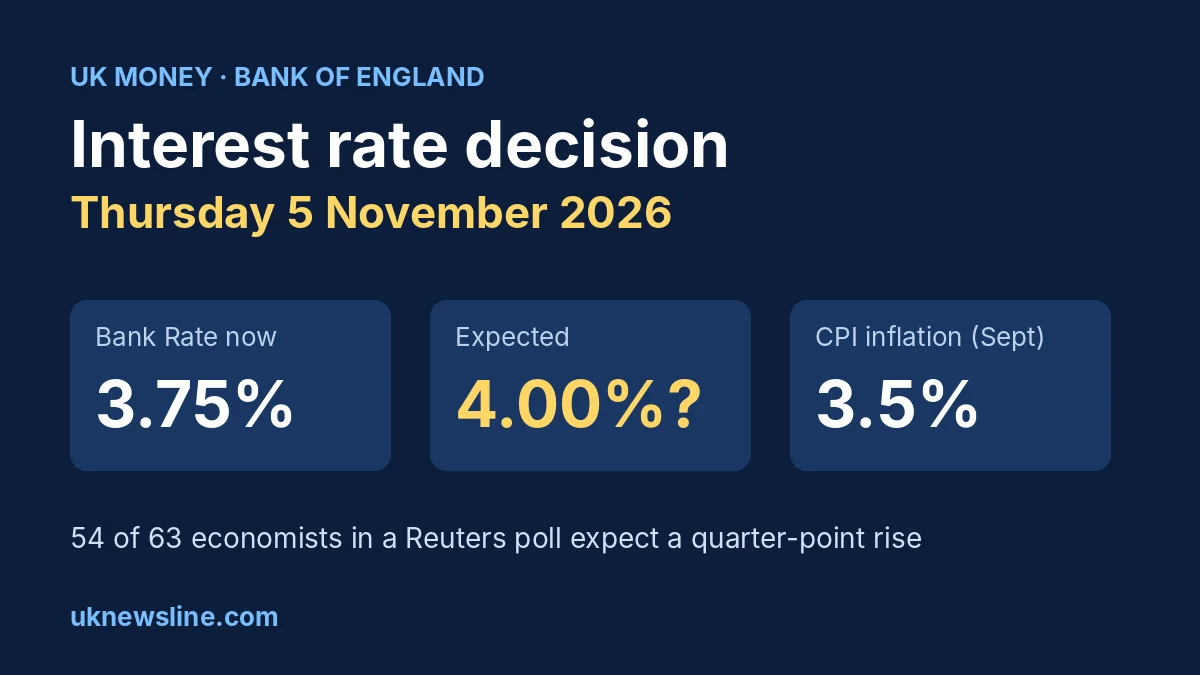
The Bank of England will announce its next interest rate decision at 12 noon on Thursday 5 November 2026, and for the first time in more than three years most economists expect Bank Rate to go up, not down. A sharp rise in petrol and diesel prices has pushed inflation back to 3.5%, and three of the nine members of the Monetary Policy Committee (MPC) already voted for a rise in September.
Here is where things stand, what is expected, and what a rise to 4% would mean for mortgages and savings.
Where interest rates are now
Here’s what you need to know:
Bank Rate is 3.75%. At its last meeting, announced on 17 September 2026, the MPC voted 6–3 to hold. According to the Bank’s minutes, Megan Greene, Catherine Mann and Huw Pill voted to raise the rate to 4%; Governor Andrew Bailey and the other five members voted to keep it unchanged.
In the minutes, Mr Bailey said holding was right for that meeting, but that policy might need to tighten if the conflict in the Middle East lasted and higher energy prices started to feed through into wider prices and wages. The Committee said it stood ready to act to bring inflation back to its 2% target.
Why a rise is now expected
| Measure (ONS, published 21 Oct 2026) | August 2026 | September 2026 |
|---|---|---|
| CPI inflation | 3.1% | 3.5% |
| Core CPI (excludes energy, food, alcohol, tobacco) | 2.6% | 2.8% |
| Services inflation | 3.4% | 3.7% |
| Motor fuel prices, 12-month change | 23.0% | 29.8% |
The Office for National Statistics said the largest upward contribution came from transport, particularly motor fuels. Food was not the problem: food inflation was unchanged at 1.3%. The worry for the Bank is that core and services inflation are also edging up, a sign that higher energy costs may be spreading into other prices.
Economists have shifted quickly. In a Reuters poll carried out on 12–14 October, 54 of 63 economists expected a quarter-point rise to 4% on 5 November. In the same poll a month earlier, about nine in ten expected rates to stay on hold for the rest of 2026.
What happens after November?
There is much less agreement about the path beyond November. In the October Reuters poll, 30 of 61 economists expected one more rise in the first three months of 2027, which would take Bank Rate to 4.25%. Money markets have priced in more than that, around four quarter-point rises by the end of 2027, although the Bank’s chief economist, Huw Pill, has questioned that pricing. Much will depend on oil prices and whether wage growth picks up.
Alongside the decision, the Bank is due to publish its quarterly Monetary Policy Report, with new forecasts for inflation and growth. The forecasts and the vote split will show how many members think further rises are needed.
What a rise to 4% would mean for you
Tracker and variable-rate mortgages
If your mortgage tracks Bank Rate, your rate would normally rise by 0.25 percentage points from your next payment date after the change. As an example, on a £200,000 repayment mortgage over 25 years, a tracker rate rising from 4.50% to 4.75% would add about £29 a month (from roughly £1,112 to £1,140). Standard variable rates are set by each lender and often, but not always, follow Bank Rate.
Fixed-rate mortgages
If you are on a fixed deal, your payments do not change until the deal ends. New fixed rates are priced from swap rates in financial markets, which already moved up in early October as expectations of a rise grew. That means much of a November rise may already be reflected in the fixed deals on offer. If your deal ends in the next six months, many lenders let you secure a new rate in advance; it is worth comparing options with a mortgage adviser.
Savings
A higher Bank Rate usually means better savings rates, particularly on easy-access accounts, but banks do not have to pass on increases in full or straight away. Inflation at 3.5% means a savings account needs to pay more than that just to keep your money’s value.
Key dates
- Thursday 5 November 2026, 12 noon: Bank Rate decision, minutes and Monetary Policy Report.
- Wednesday 18 November 2026: next ONS inflation figures (for October).
- Thursday 17 December 2026: final Bank Rate decision of 2026.
For background on how the Bank sets rates and how decisions affect mortgages, read our explainer: Bank of England interest rate: next decision date and what it means for your mortgage. We will update this article with the result on 5 November.
This article is for information only and is not financial advice.
Sources: ONS – Consumer price inflation, UK: September 2026; Bank of England Monetary Policy Summary and minutes, September 2026, as reported by Securities.io and Trading Economics; Reuters economists’ poll (12–14 October 2026) as reported by Global Banking & Finance Review and HomeOwners Alliance.